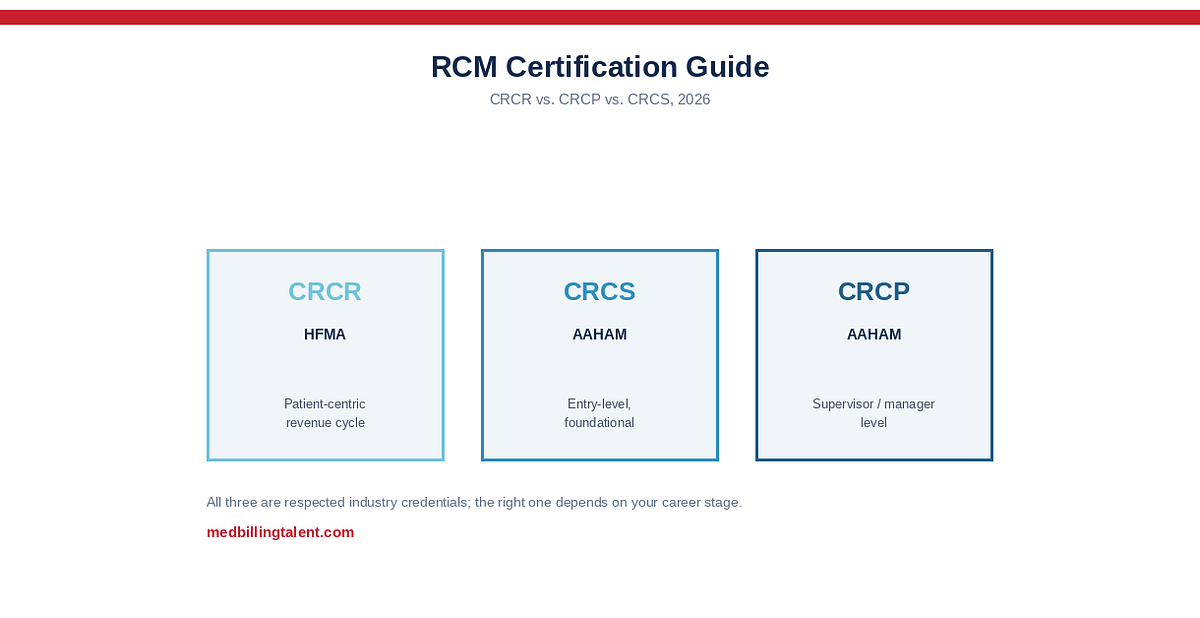
RCM Certification Guide: CRCR vs. CRCP vs. CRCS (2026)
Revenue cycle management (RCM) has its own set of professional certifications, separate from medical billing and coding credentials. If you're working in RCM or aiming to move into an RCM analyst role, three common certifications are the CRCR, CRCS, and CRCP. Here's how they compare.
RCM Certification Comparison
| CRCR | CRCS | CRCP | |
|---|---|---|---|
| Issuing body | HFMA | AAHAM | AAHAM |
| Full name | Certified Revenue Cycle Representative | Certified Revenue Cycle Specialist | Certified Revenue Cycle Professional |
| Career level | Early to mid-career (1+ years of experience recommended) | First rung of AAHAM's ladder (about 1 year of experience recommended) | Supervisor / manager |
| Focus | Patient-centric revenue cycle: patient access, registration, billing, claims management | Registration (front desk), billing, credit and collections | Patient access, billing, credit/collections, RCM oversight |
CRCR: Certified Revenue Cycle Representative
Offered by HFMA (Healthcare Financial Management Association), the CRCR is built around the modern, patient-centric revenue cycle. It covers workflows for patient access, registration, billing, claims management, and patient financial conversations. HFMA recommends one or more years of revenue cycle experience before taking it, and the assessment is 75 multiple-choice questions in 90 minutes, with a 70% passing score.
CRCS: Certified Revenue Cycle Specialist
Offered by AAHAM (American Association of Healthcare Administrative Management), the CRCS is the first rung of AAHAM's certification ladder. It's a two-hour, online, proctored exam on registration (front desk), billing, and credit and collections, and AAHAM recommends about one year of healthcare revenue cycle employment before sitting it.
CRCP: Certified Revenue Cycle Professional
Also from AAHAM, the CRCP sits a level above the CRCS and targets supervisors and managers. It's a four-hour proctored exam covering patient access, billing, credit and collections, and revenue cycle management, and it requires AAHAM membership plus two years of healthcare-related experience or an associate degree.
Which one should you get?
If you're newer to revenue cycle work and have about a year behind you, the CRCS is a foundational credential and the first step on AAHAM's ladder. If you work across the patient-facing side of the cycle, the CRCR is HFMA's national certification for exactly that. If you're already supervising or managing a revenue cycle team, the CRCP is built specifically for that level. See our revenue cycle analyst salary guide for what these roles pay.
Where to find remote RCM analyst roles
Med Billing Talent lists current remote, US-based RCM analyst openings, screened to exclude offshore and outsourced postings. Browse Revenue Cycle Management (RCM) Analyst jobs →
Related Articles:
- Revenue Cycle Analyst Salary Guide
- What Does a Revenue Cycle Analyst Do?
- Medical Coding Certification Guide
Sources: HFMA CRCR, AAHAM CRCS, AAHAM CRCP, O*NET CRCR Certification (USDOL/ETA)