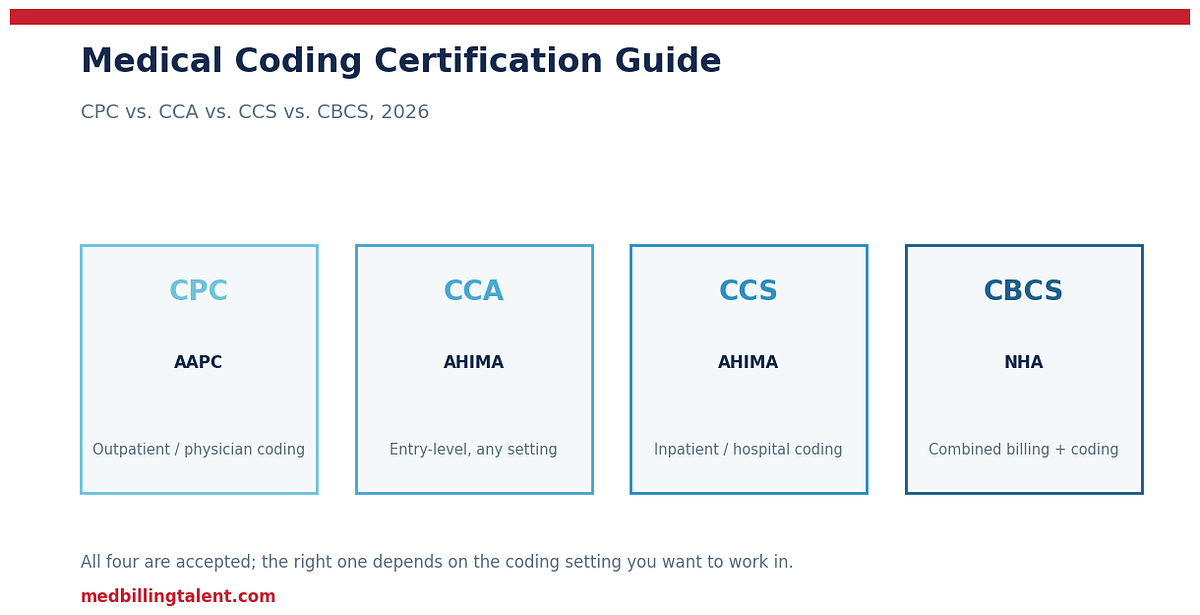
Medical Coding Certification Guide (2026): CPC vs. CCA vs. CCS vs. CBCS
Medical coding certification is one of the most searched topics in this field, and for good reason - it's usually the single biggest factor in whether you get hired without prior experience. But there isn't just one certification. Four show up most often in job postings, and each is built for a slightly different setting.
CPC (Certified Professional Coder) - AAPC
The most widely recognized coding certification, and the default choice for outpatient and physician-office coding. No experience is required to sit the exam, though candidates without two years of on-the-job experience carry a CPC-A (Apprentice) designation until they log that time. If you're not sure which certification to start with, this is usually the safest default - it's the one most employers recognize on sight.
CCA (Certified Coding Associate) - AHIMA
An entry-level credential designed specifically for people with little or no coding experience, valid across both inpatient and outpatient settings. It's a common first step for people who plan to eventually pursue the more specialized CCS credential once they have some real-world coding time logged.
CCS (Certified Coding Specialist) - AHIMA
Focused on inpatient and hospital-based coding, and generally considered more advanced than CPC or CCA. Most people pursue CCS after they already have coding experience, since the exam assumes familiarity with complex hospital records. It carries real weight for hospital coding roles and tends to correlate with higher pay.
CBCS (Certified Billing and Coding Specialist) - NHA
Unlike the other three, CBCS covers both billing and coding together rather than coding alone. It's a good fit if you're aiming for a hybrid role - common at smaller practices where one person handles both functions - rather than a pure coding position.
Which one should you get first?
- Want outpatient/physician coding, no experience yet: CPC
- Want the lowest barrier to entry, any setting: CCA, then CCS later
- Targeting hospital/inpatient coding specifically: CCS (after some experience)
- Want a hybrid billing + coding role: CBCS
All four are legitimate, recognized credentials - there's no wrong choice here, only a better or worse fit for the specific coding job you're targeting. Many coders eventually hold more than one as their career moves between settings.
What the exams actually involve
Each exam tests your ability to assign correct codes from clinical documentation using CPT, ICD-10-CM, and HCPCS Level II code sets, plus coding guidelines and compliance basics. Most candidates prepare through a certificate program (several months to two years) or self-study with an official exam prep course, rather than a full college degree.
Where to find remote medical coder roles
Med Billing Talent lists current remote, US-based medical coder openings, screened to exclude offshore and outsourced postings. Browse Medical Coder jobs →
Related article: Medical Billing vs. Medical Coding