Entry-Level Medical Billing Jobs: How to Land Your First Role (2026)
Medical billing is one of the more accessible entry points into healthcare administration - no nursing degree, no clinical background required. But "entry-level" in this field usually means a specific set of feeder job titles and a realistic path, not a straight line into a fully remote role on day one. Here's what that path actually looks like.
What counts as an entry-level role
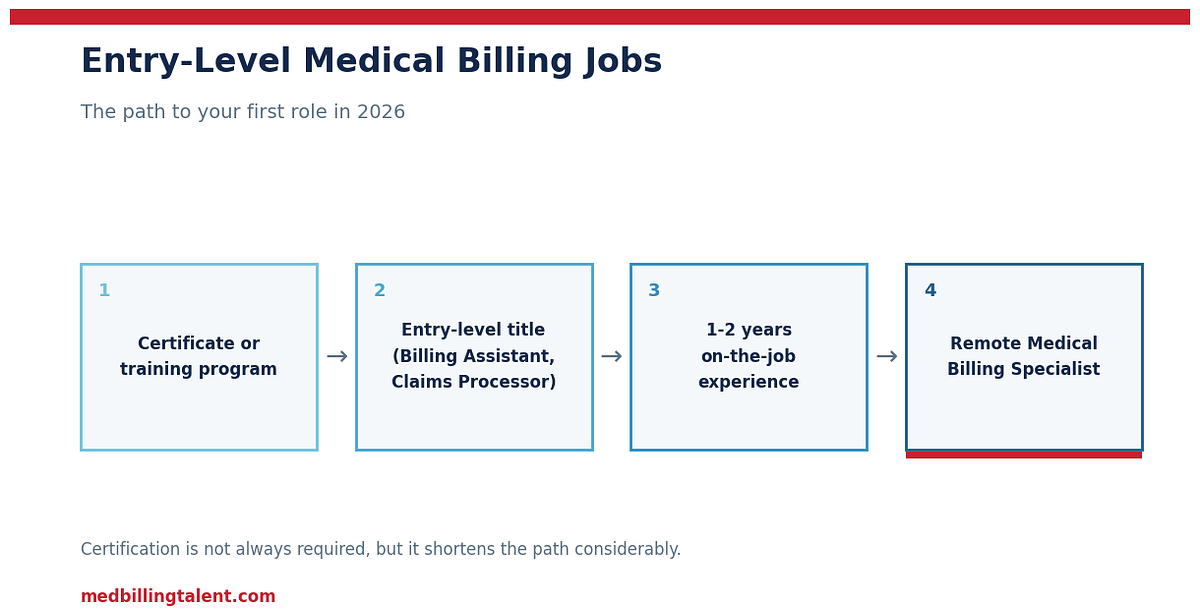
Most people don't start with the title "Medical Billing Specialist." They start in adjacent roles that build the same skills:
- Medical Billing Assistant
- Claims Processor / Biller
- Medical Billing Clerk
- Medical Front Office / Medical Receptionist
These titles show up far more often in "no experience required" postings than "Medical Billing Specialist" does, and they teach the exact workflows - insurance verification, claims software, payer communication - that specialist roles expect you to already know.
Typical entry-level pay
Entry-level medical biller roles commonly start in the mid-$30,000s to high-$40,000s annually, with entry-level medical coder roles in a similar range. Pay climbs meaningfully once you have 1-2 years of experience and, ideally, a certification behind you.
Do you need a certification to start?
Not always - but it changes your odds significantly. A certification like the CBCS (Certified Billing and Coding Specialist) from NHA is specifically designed for entry-level candidates with no prior experience, and most training programs that lead to it run a matter of months, not years. Certification signals to an employer that you already know the code sets and claims process, which shortens the on-the-job training they'd otherwise need to provide.
The honest truth about remote entry-level roles
Fully remote positions disproportionately ask for one to two years of experience, because employers want billers who already know core workflows before working unsupervised. That doesn't mean remote is out of reach - it means the realistic path for most people is: build initial experience in an on-site or hybrid entry-level role first, then move remote once you have that track record. Employers are far more willing to let an experienced biller work remotely than to train a total beginner remotely from day one.
How to actually get hired with no experience
- Target the right titles. Search "billing assistant" and "claims processor," not just "medical billing specialist."
- Get a foundational certification. CBCS or a similar entry-level credential is worth more than a generic resume line.
- Network inside the field. Local AAPC or AHIMA chapter meetings and healthcare admin forums surface openings that never get posted publicly.
- Apply to smaller practices. Solo and small-group practices are often more willing to train than large hospital systems.
Where to find remote medical billing roles
Med Billing Talent lists current remote, US-based medical billing openings, screened to exclude offshore and outsourced postings - a good place to track what experienced remote roles actually require once you're ready to make that move. Browse Medical Billing Specialist jobs →
Related reading: Medical Biller Salary Guide | Medical Biller Requirements | Medical Billing vs. Medical Coding