Medical Billing vs. Medical Coding: What's the Difference? (2026)
Medical billing and medical coding get used interchangeably all the time, and many job postings blend the two into one hybrid role. But they are distinct jobs with different day-to-day work, different skill sets, and different places in the revenue cycle. Knowing the difference matters if you are deciding which career path to pursue, or which certification to invest in first.
What is medical coding?
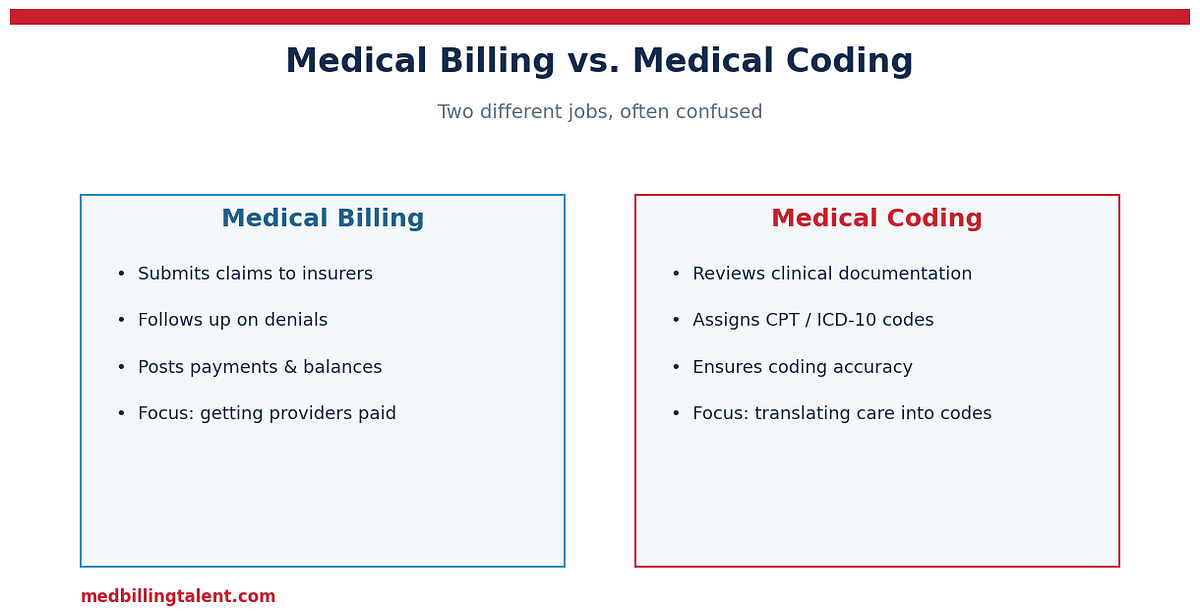
A medical coder reviews clinical documentation from a patient encounter and translates it into standardized codes:
- Assigning ICD-10-CM codes for diagnoses
- Assigning CPT codes for procedures and services performed
- Assigning HCPCS Level II codes for supplies and equipment
- Ensuring the codes accurately reflect what the documentation supports
Coding happens earlier in the process. A coder's output - the finished set of codes - is what a biller then uses to build a claim.
What is medical billing?
A medical biller takes the coded information and turns it into revenue:
- Verifying patient insurance eligibility
- Creating and submitting claims to payers
- Posting payments and adjustments from insurers and patients
- Identifying and correcting denied or underpaid claims, then resubmitting
- Generating patient statements and following up on balances
Billing is the follow-through: it doesn't stop when the claim goes out, it continues until the provider is actually paid.
Key differences at a glance
- What they touch: coders work with clinical documentation; billers work with claims and payments
- Where they sit: coders are more often inside healthcare facilities with direct record access; billers can work in hospitals, clinics, or third-party billing agencies
- Certifications: CPC and CCS lean toward coding; CPB and CBCS cover billing (CBCS blends both)
- The overlap: many smaller practices combine both into one role, and plenty of professionals are trained and certified in both
Which pays more?
Pay ranges overlap significantly and depend more on experience, certification, and employer than on which title you hold. Specialized coding roles (inpatient, HCC/risk adjustment) and specialized billing roles (denial management, accounts receivable) tend to pay above the general median in both tracks - specialization moves pay more than the billing/coding label does.
Which one should you pursue?
If you're drawn to detail-oriented documentation review and want a clear certification path, coding (CPC, CCS) is the more direct route. If you'd rather work the financial and payer-relations side, including patient and insurer communication, billing (CPB, CBCS) fits better. Many people start in a hybrid billing/coding role and specialize later once they know which side of the work they prefer.
Where to find remote roles in either track
Med Billing Talent lists current remote, US-based openings across both billing and coding roles, screened to exclude offshore and outsourced postings. Browse Medical Billing Specialist jobs → or Browse Medical Coder jobs →
Related reading: Medical Biller Salary Guide | Medical Biller Requirements | Entry-Level Medical Billing Jobs