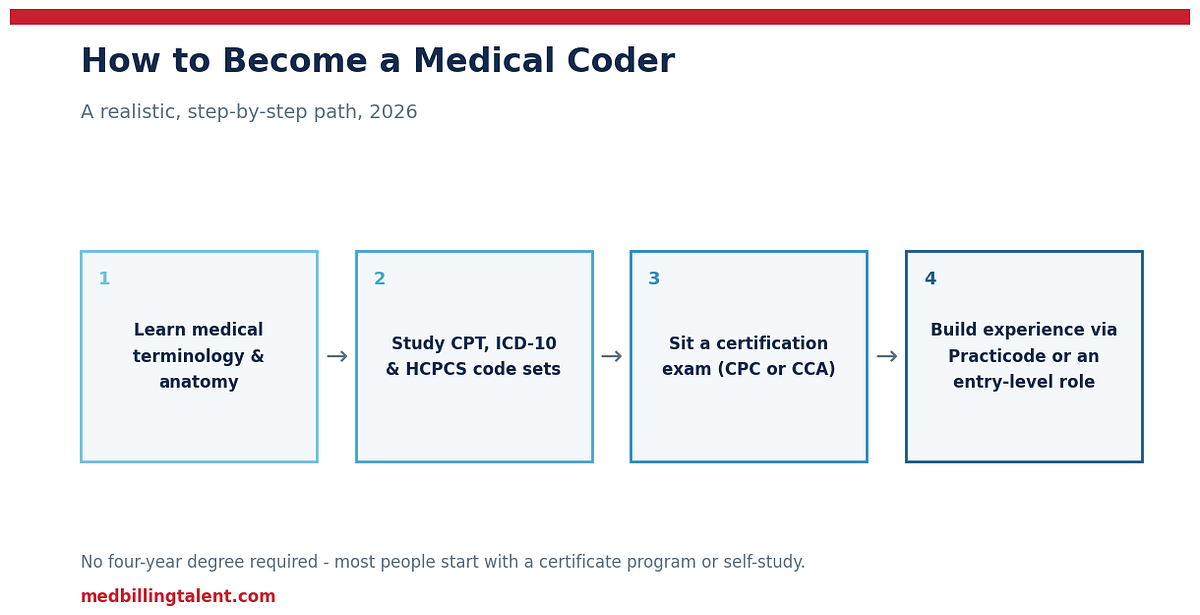
How to Become a Medical Coder: Step-by-Step (2026)
Becoming a medical coder doesn't require a four-year degree or years of prior healthcare experience - but it does require a specific sequence: learn the fundamentals, get certified, then find a way around the "experience required" wall that catches almost everyone on their first job search. Here's the realistic path, not the oversimplified version.
Step 1: Learn medical terminology and anatomy
Before you can code anything, you need to understand what you're reading. Medical terminology, basic anatomy, and physiology are the foundation every coding certification exam builds on. Most certificate programs start here for a reason - skipping ahead to code sets without this foundation is the most common way people struggle with the certification exam later.
Step 2: Learn the code sets
Once the fundamentals are solid, the core skill is translating clinical documentation into three code sets:
- ICD-10-CM - diagnosis codes
- CPT - procedure and service codes
- HCPCS Level II - supplies, equipment, and services outside CPT
You can learn this through a formal certificate program (typically several months to two years) or through self-study using official exam-prep materials - both paths are legitimate, and employers generally care more about the certification you end up with than how you got there.
Step 3: Get certified
Most people starting out choose between two credentials:
- CPC (AAPC) - the most widely recognized certification, geared toward outpatient/physician coding
- CCA (AHIMA) - built specifically for entry-level candidates, valid across settings
See our full certification comparison guide if you're unsure which fits your goal.
Step 4: Get past the "2 years experience" wall
This is where most people get stuck. Pass the CPC exam without prior coding experience and you'll carry a "CPC-A" (Apprentice) designation - a signal to employers that you have the knowledge but haven't applied it professionally yet. The good news: you don't have to wait two years to remove it. AAPC's Practicode program - a set of real-world coding case modules - can clear the Apprentice status in as little as a year, and it's worth prioritizing over just accumulating job-search rejections while waiting it out.
In the meantime, entry-level titles like Coding Assistant or Coding Quality Auditor Trainee are far more open to CPC-A candidates than roles simply titled "Medical Coder."
Realistic timeline
Expect roughly 4-12 months from starting to study to passing your first certification exam, depending on whether you study full-time or part-time. Add another few months to a year of Practicode or entry-level work before you're a fully competitive candidate for open "Medical Coder" postings - it's a real investment, but a shorter and cheaper one than most healthcare careers.
Where to find remote medical coder roles
Med Billing Talent lists current remote, US-based medical coder openings, screened to exclude offshore and outsourced postings. Browse Medical Coder jobs →
Related articles: Medical Coder Salary Guide | Medical Billing vs. Medical Coding