What Does a Medical Coder Do? Job Description & Day-to-Day (2026)
A medical coder's job comes down to one core task: turning what happened during a patient encounter into standardized codes that insurers, providers, and regulators can all understand. But the actual day-to-day work involves a lot more judgment and back-and-forth than "look up a code" suggests.
Reviewing clinical documentation
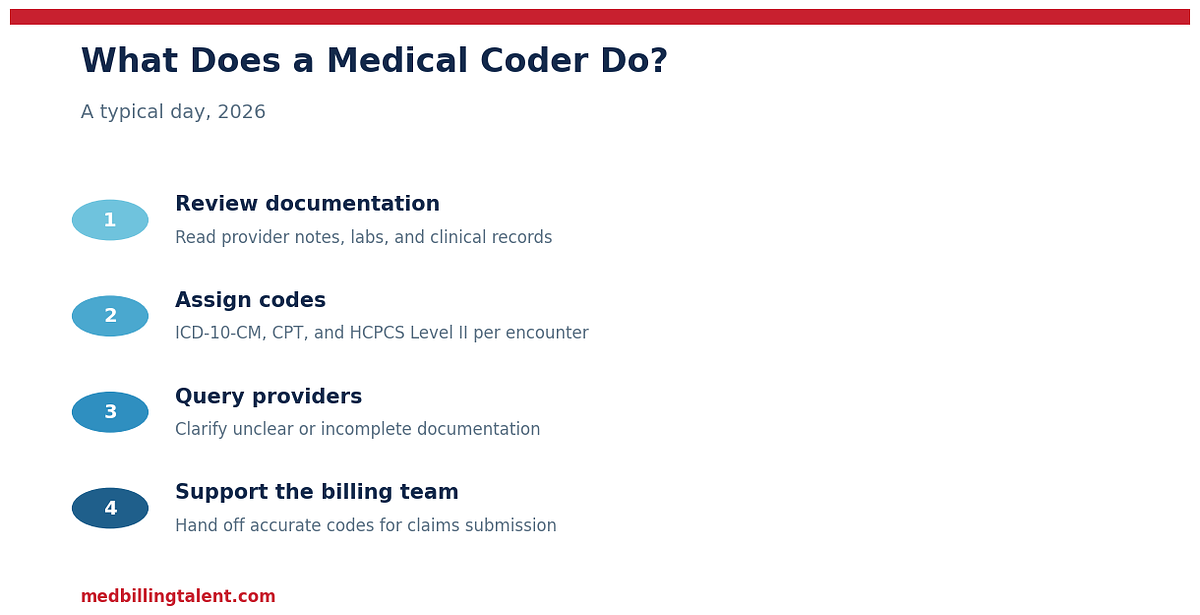
The day starts with a stack of patient records - provider notes, lab results, discharge summaries, operative reports. The coder reads through each one to understand exactly what was diagnosed, tested, or treated during that encounter. This is the most detail-sensitive part of the job: missing a detail in the documentation means missing or misassigning a code later.
Assigning codes
From that documentation, the coder assigns:
- ICD-10-CM codes for every diagnosis
- CPT codes for procedures and services performed
- HCPCS Level II codes for supplies, equipment, or services outside CPT
Accuracy matters more than speed here, though most roles do track both - incorrect codes lead directly to denied claims, compliance flags, or lost revenue for the provider.
Querying providers
Documentation is often incomplete or ambiguous. When that happens, coders send a formal "query" back to the provider asking for clarification - for example, confirming whether a condition was actually diagnosed or just ruled out. This is a routine, expected part of the workflow, not a sign something went wrong.
Working with the billing team
Once codes are finalized, they get handed off to medical billers, who use them to build and submit insurance claims. In smaller practices, one person often does both jobs; in larger organizations, coding and billing are separate roles that work closely together. See our Medical Billing vs. Medical Coding breakdown for exactly where that line falls.
Tools of the job
Coders typically work inside an EHR or practice management platform (Epic, Athenahealth, Cerner) alongside encoder software or reference manuals for the code sets themselves. Most roles also involve some coding-audit or quality-review work - either being audited, or auditing others' work for accuracy.
What makes someone good at this job
- Strong attention to detail - the job is unforgiving of small misreads
- Comfort with ambiguity - documentation isn't always clean or complete
- Solid grasp of anatomy, physiology, and medical terminology
- Ability to work independently against volume or accuracy targets
Where to find remote medical coder roles
Med Billing Talent lists current remote, US-based medical coder openings, screened to exclude offshore and outsourced postings. Browse Medical Coder jobs →
Related articles: How to Become a Medical Coder | Medical Coder Salary Guide