What Is a Credentialing Specialist? (2026)
Providers who treat patients, bill insurance, or join a hospital's medical staff generally have to be credentialed first. That process is handled by credentialing specialists, and it's one of the most detail-driven, compliance-critical roles in healthcare administration.
What is a credentialing specialist?
A credentialing specialist verifies that healthcare providers, physicians, nurse practitioners, and other licensed practitioners, meet the qualifications required to practice and bill within a healthcare organization or insurance network. This means confirming education, training, licensure, work history, and any red flags like malpractice claims or sanctions, before a provider is approved to see patients or submit claims.
Why credentialing matters
- Patient safety: credentialing confirms a provider is actually qualified and licensed to practice
- Compliance: hospitals and health plans follow accrediting standards, such as those from NCQA and The Joint Commission, that call for thorough credentialing records
- Revenue protection: a provider who isn't properly credentialed with a payer can cause claims to be denied (see our guide to denial management)
- Risk management: catching sanctions or malpractice history protects the organization and its patients
How the credentialing process works
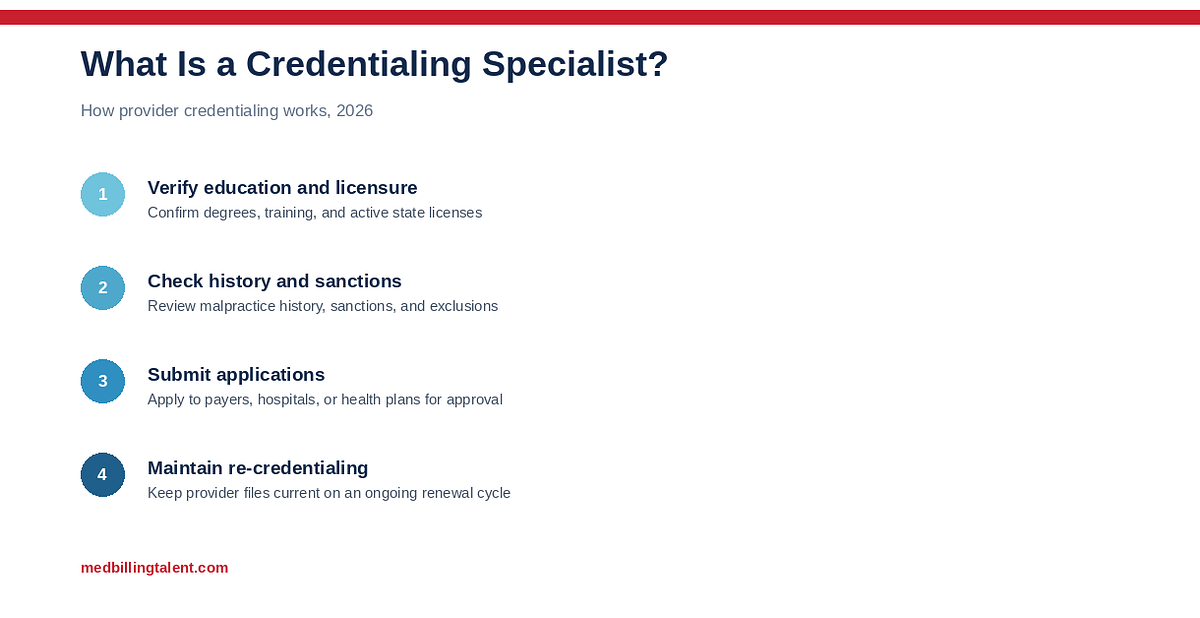
- Verify education and licensure - confirming degrees, residency or training, and that state licenses are active and in good standing
- Check history and sanctions - reviewing malpractice history, disciplinary actions, and exclusion lists
- Submit applications - completing and submitting credentialing applications to payers, hospitals, or health plans
- Maintain re-credentialing - keeping provider files current, since most credentials must be renewed on a regular cycle, typically every two to three years (NCQA requires recredentialing at least every 36 months, and The Joint Commission allows up to three years, or less where state law requires)
Who does credentialing work?
Credentialing specialists work in hospitals, medical groups, health plans, and credentialing verification organizations (CVOs). Employers typically prefer prior credentialing, medical staff services, or healthcare administration experience, and the role is well suited to detail-oriented people who are comfortable with compliance-heavy, document-driven work. See how to become a credentialing specialist for the career path, or the CPCS certification guide for the main credential in this field.
Where to find remote credentialing jobs
Med Billing Talent lists current remote, US-based credentialing openings, screened to exclude offshore and outsourced postings. Browse Credentialing Specialist jobs →
Related Articles:
- Credentialing Specialist vs. Credentialing Coordinator
- CPCS Certification Guide
- How to Become a Credentialing Specialist
Sources: NCQA (Credentialing FAQs), Horty Springer (Joint Commission reappointment change), Robert Half (Credentialing Specialist)