Denial Management in Medical Billing: What It Is, How It Works, and Who Does It (2026)
Denial management is how healthcare providers prevent, find, fix, and learn from insurance claim denials. Every denied claim is money that has not been collected yet, so the work sits at the center of revenue cycle management. This guide covers what denial management is, why claims get denied, how the process works, which metrics matter, and who does the work.
What Is Denial Management in Medical Billing?
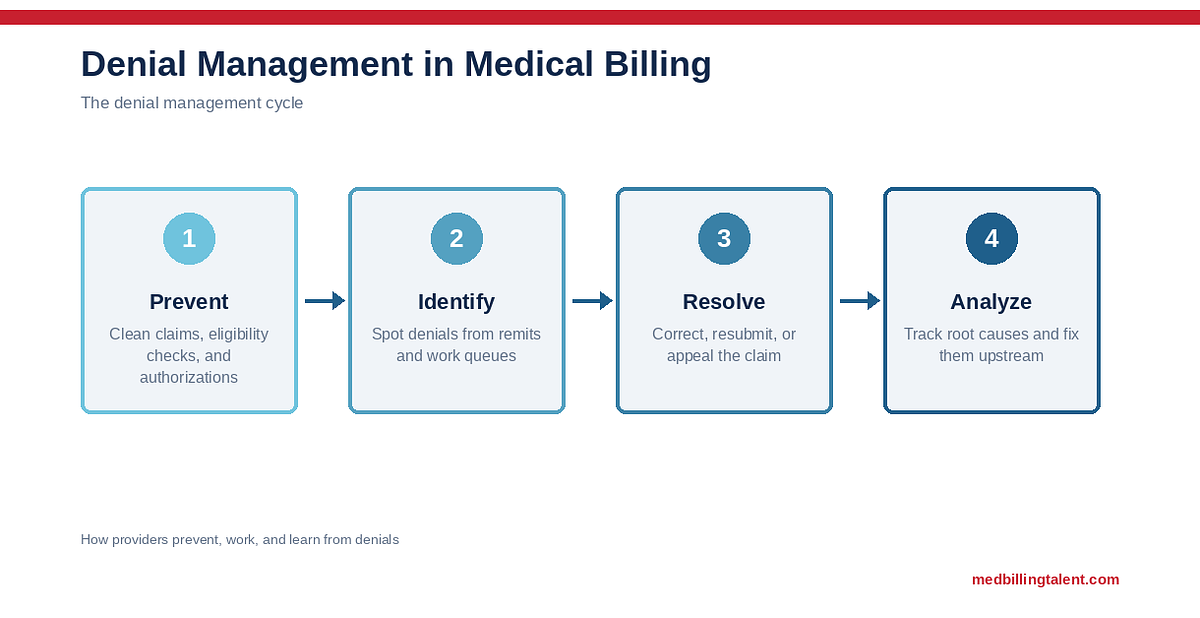
Denial management in medical billing is the set of steps a provider or billing company uses to handle claims that a payer refuses to pay or pays less than expected. It covers three things: preventing denials before claims go out, working denied claims quickly, and fixing the root causes so the same denials stop repeating. When people ask what denial management is, the short answer is that it turns denied claims into paid claims and uses what it learns to deny fewer in the future.
How Common Are Claim Denials?
Denials are common enough that most organizations have staff dedicated to them. Kodiak Solutions reported an overall initial denial rate of 10.63% for the first half of 2026, down from 12.00% a year earlier, with traditional Medicare much lower at about 4.21%. MGMA's July 2026 data puts the typical first-submission denial rate for medical practices at 7% to 8%, with well-run practices getting under 5%.
Why Claims Get Denied
- Registration and eligibility errors: wrong insurance details or inactive coverage
- Missing or incorrect information: incomplete claim fields or missing documentation
- Authorization problems: no prior authorization or referral on file
- Coding and bundling issues: incorrect codes, missing modifiers, or services the payer considers part of another procedure
- Medical necessity: the payer decides the documentation does not support the service
- Timely filing: the claim reached the payer after the deadline
Many denials start with coding, which is why billing and coding teams work closely together. If you are weighing the two career paths, read medical billing vs medical coding.
The Denial Management Process
- Prevent. Verify eligibility, get authorizations, and use claim scrubbing to catch errors before submission.
- Identify. Find denials on the electronic remittance and in work queues.
- Categorize. Group each denial by root cause, such as eligibility, coding, authorization, or documentation.
- Resolve. Correct and resubmit the claim, or file an appeal with supporting documentation before the payer's deadline.
- Analyze. Track patterns by payer, provider, and denial reason.
- Fix upstream. Send what you find back to registration, coding, and clinical teams so the cause stops.
Denial Management metrics to know
- Initial denial rate: the share of claims denied on first submission
- Clean claim rate: the share of claims accepted and paid without rework
- Final denial rate: denials that are never recovered and end up written off
- Days in AR: how long it takes to collect, covered in medical billing accounts receivable
Healthcare Denials Management: Who Does The Work?
Several roles share the work. Denial management specialists work the denied claims every day, and our guide to the denial management specialist role covers the duties and skills. Analysts track trends and recommend fixes, and clinical reviewers handle medical necessity appeals. Accounts receivable teams also work denials as part of follow up, as described in the accounts receivable specialist guide. For the roles that are hiring, see denial management jobs.
Denial Management Software
Many teams use denial management software, clearinghouse tools, and EHR work queues to flag, route, and track denials. The software finds patterns, but people still decide what to correct, what to appeal, and what to write off. If your target employer uses Epic, our guide to Epic Resolute billing shows where denial work happens in that system.
Learning Denial Codes And Real Scenarios
Every denial arrives with codes that explain the reason. Learn how to read them in medical billing denial codes, then practice with common cases in AR denial scenarios.
Where To Find Remote Roles
Browse current openings on our Denial Management jobs page, or check Accounts Receivable Specialist jobs for related roles. Every listing on Med Billing Talent is remote and US-based.