AR Denial Scenarios in Medical Billing: Common Cases and How to Handle Them (2026)
AR denial scenarios are the real-world cases an accounts receivable follow up specialist works every day: a claim comes back denied, and you have to figure out why and what to do. This guide walks through eight common scenarios, the code behind each, and the first step to take, so you can practice before the job or sharpen your approach if you already do it.
How An AR Denial Call Usually Goes
- Review the denial. Read the group code, CARC, and RARC on the remittance.
- Check the account. Confirm eligibility, authorization, and what was billed.
- Contact the payer or check the portal. Confirm the reason and ask what is needed to fix it.
- Correct or appeal. Resubmit with corrections or file an appeal.
- Document everything. Record the date, who you spoke to, and the next step.
For the full process behind this, see denial management in medical billing.
8 Common AR Denial Scenarios
1. Missing or incorrect information (CO 16)
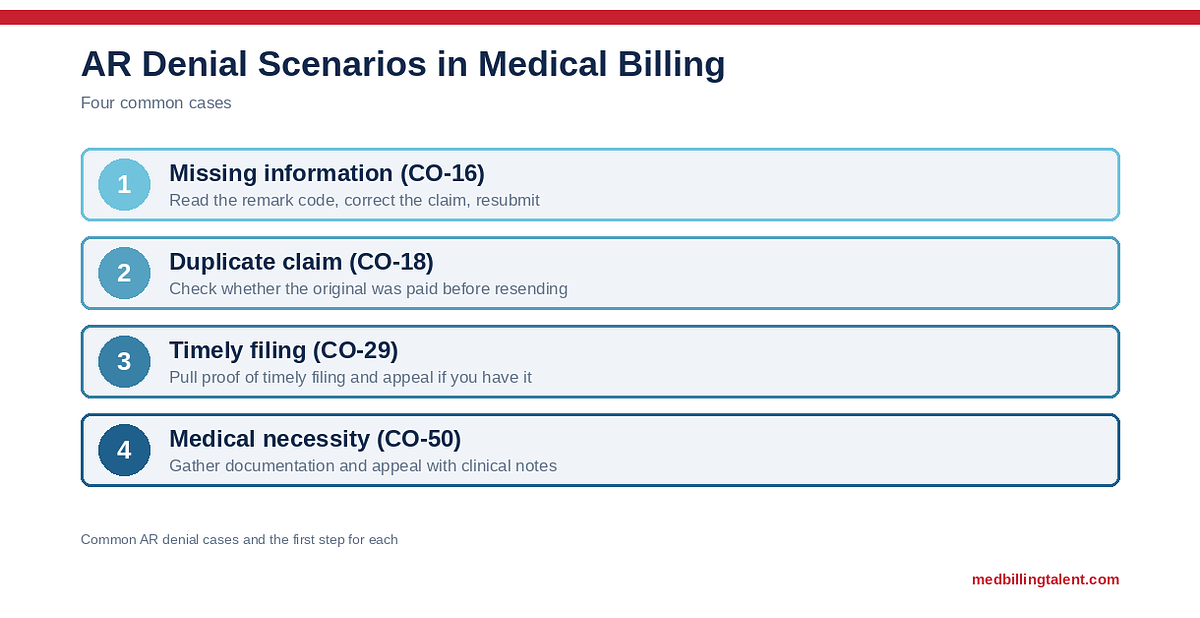
The claim lacks information or has a submission error. The accompanying remark code tells you what is missing, such as an NPI, diagnosis, or authorization number. First step: read the remark code, correct the claim, and resubmit.
2. Duplicate claim (CO 18)
The payer says it already received this claim. First step: check whether the original was paid or is still processing before resending anything.
3. Timely filing (CO 29)
The filing deadline passed. First step: pull your proof of timely filing, such as the clearinghouse acceptance report, and appeal if you can show the claim was filed on time.
4. Medical necessity (CO 50)
The payer says the service was not medically necessary. First step: gather the clinical documentation and appeal with notes that match the payer's criteria. See medical billing denial codes for more on this code.
5. Bundled or incidental service (CO 97 or remark N19)
The payer considers the service included in another procedure. First step: review the coding and the payer's bundling edits. Appeal only if there is documentation showing the service was separate.
6. Coordination of benefits (CO 22)
Another payer may be primary. First step: verify the patient's coverage order, update the account, and bill the correct payer first.
7. Missing prior authorization (CO 197)
The payer says the required authorization was absent. First step: check whether authorization was obtained and attached, and ask the payer about a retroactive review or an appeal.
8. Coverage terminated (CO 27)
The patient's coverage ended before the date of service. First step: verify eligibility, look for new coverage, and if none exists, move the balance to the patient according to your policy.
What Does an AR Follow Up Specialist Checks On Every Call
- The claim number and date of service
- The exact denial reason and codes
- The deadline to correct or appeal
- What the payer needs: records, a corrected claim, or a written appeal
- A call reference number and the name of the person you spoke with
Strong notes are a big part of the job. For how AR work fits into the billing cycle, read medical billing accounts receivable, and for the career path see the accounts receivable specialist guide.
Where To Find Remote Roles
Browse current openings on our Denial Management jobs page, or check Accounts Receivable Specialist jobs for related roles. Every listing on Med Billing Talent is remote and US-based.