Accounts Receivable Specialist: Job Description, Salary, and Skills (2026)
An accounts receivable specialist makes sure a company gets paid for what it has already sold or delivered. In healthcare, that means tracking money owed by insurance payers and patients, and chasing it until the balance is closed. This guide covers the job description, daily duties, skills, pay, and the steps to get started.
What is an accounts receivable specialist?
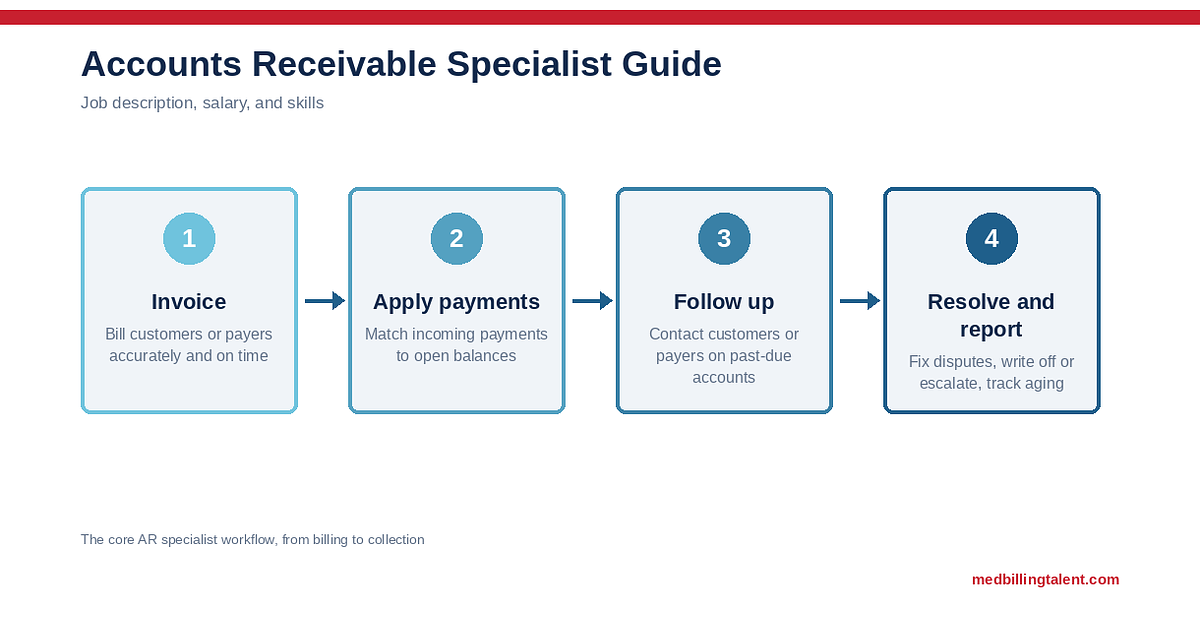
An accounts receivable (AR) specialist manages the money a business is owed. They send invoices or statements, apply incoming payments to the right accounts, follow up on past-due balances, and report on what is still outstanding. The role sits between a clerk, who mostly processes transactions, and an analyst, who focuses more on reporting and trends. See our breakdown of accounts receivable specialist vs clerk vs analyst for the full comparison.
What does an accounts receivable specialist do?
Day to day, most AR specialists work through the same cycle:
- Prepare and send invoices or statements accurately and on time
- Post payments and match them to open balances
- Contact customers or payers about past-due accounts
- Investigate short payments, disputes, and billing errors
- Review aging reports and flag accounts for escalation or write-off
- Reconcile accounts and support month-end close
If you are asking what an account receivable specialist does in a healthcare setting, the cycle is the same, but the "customer" is usually an insurance company. The work centers on unpaid and denied claims. We cover that version in detail in medical billing accounts receivable.
Accounts receivable specialist job description
Here is a typical job description of an accounts receivable specialist, based on how employers commonly write the role:
Summary: Responsible for managing the receivables cycle, including billing, payment posting, collections follow up, and account reconciliation, while keeping aged balances as low as possible.
Key responsibilities:
- Process billing and post payments daily
- Work aging reports and follow up on overdue balances
- Resolve payment discrepancies and unapplied cash
- Document all account activity and communication
- Prepare AR reports for management
Typical requirements: High school diploma or equivalent (an associate or bachelor's degree in accounting or business is often preferred), 1 to 3 years of AR, billing, or collections experience, and working knowledge of accounting or practice management software.
Accounts receivable specialist skills
- Attention to detail: one wrong digit can leave a payment applied to the wrong account
- Communication: most of the job is polite, firm phone and email follow up
- Spreadsheets: Excel skills for aging reports and reconciliations
- Software: accounting platforms such as QuickBooks, NetSuite, or SAP, or healthcare systems such as Epic and athenahealth
- Organization: managing a large queue of accounts with different deadlines
- Problem solving: tracing why a balance is still open
Accounts receivable specialist salary
Pay depends heavily on location. Robert Half's 2026 salary pages for the accounts receivable specialist title show a wide spread by city: about $47,600 to $57,200 in Fort Wayne, IN, $53,100 to $63,800 in Indianapolis, $58,000 to $69,700 in Las Vegas, $63,800 to $76,600 in Philadelphia, and $72,800 to $87,400 in Boston. Its general benchmark page puts the middle of the range at roughly $60,000, with most specialists falling between about $54,750 and $65,750. Higher-cost metros sit at the top of those ranges, and remote roles often pay based on the employer's location or a national band.
For a healthcare-specific angle on pay and career growth, see our guide to medical biller salary.
How to become an accounts receivable specialist
- Build the basics. A high school diploma is the minimum, and coursework in accounting or business helps.
- Get entry-level experience. Billing clerk, payment poster, or collections assistant roles are common starting points. Our guide to entry level accounts receivable jobs covers where to look.
- Learn the software. Excel plus one accounting or practice management system goes a long way.
- Consider a certification for healthcare AR. No license is required, but credentials such as the CBCS from NHA or the CPB from AAPC can help you stand out in medical billing.
- Apply to remote openings. AR work is easy to do from home, and many employers hire remotely. See remote accounts receivable specialist jobs for what employers ask for.
Why healthcare is a strong path for AR specialists
Medical practices, billing companies, and hospitals all depend on steady collections, and unpaid insurance claims create constant demand for people who can follow up and resolve them. If you like the billing side of healthcare, you may also want to read medical billing vs medical coding to see how the two career paths differ.
Where to find remote roles
Browse current openings on our Accounts Receivable Specialist jobs page, or check Medical Billing Specialist jobs for related roles. Every listing on Med Billing Talent is remote and US-based.