CRC Certification for Medical Coders (AAPC Risk Adjustment Guide)
If you want to work in risk adjustment, the CRC is the credential employers ask for most. It shows you can review medical records and assign ICD-10-CM diagnosis codes that hold up to audit. This guide covers what CRC certification is, what the exam covers, how to get certified, and how the CRC compares to the CPC. If you are new to the specialty, start with our overview of what HCC coding is.
What Is CRC Certification?
CRC stands for Certified Risk Adjustment Coder. It is offered by AAPC and focuses on ICD-10-CM diagnosis coding for risk adjustment, especially the Medicare Advantage model. If you have wondered what a CRC certification is in practical terms, it is proof that you can find risk-adjusting diagnoses in a record, code them accurately, and follow compliance rules such as those tested in RADV audits.
Unlike a general coding credential, the CRC does not test procedure coding. Everything centers on diagnosis capture, which is why it pairs so well with HCC roles.
What Does the CRC Exam Cover?
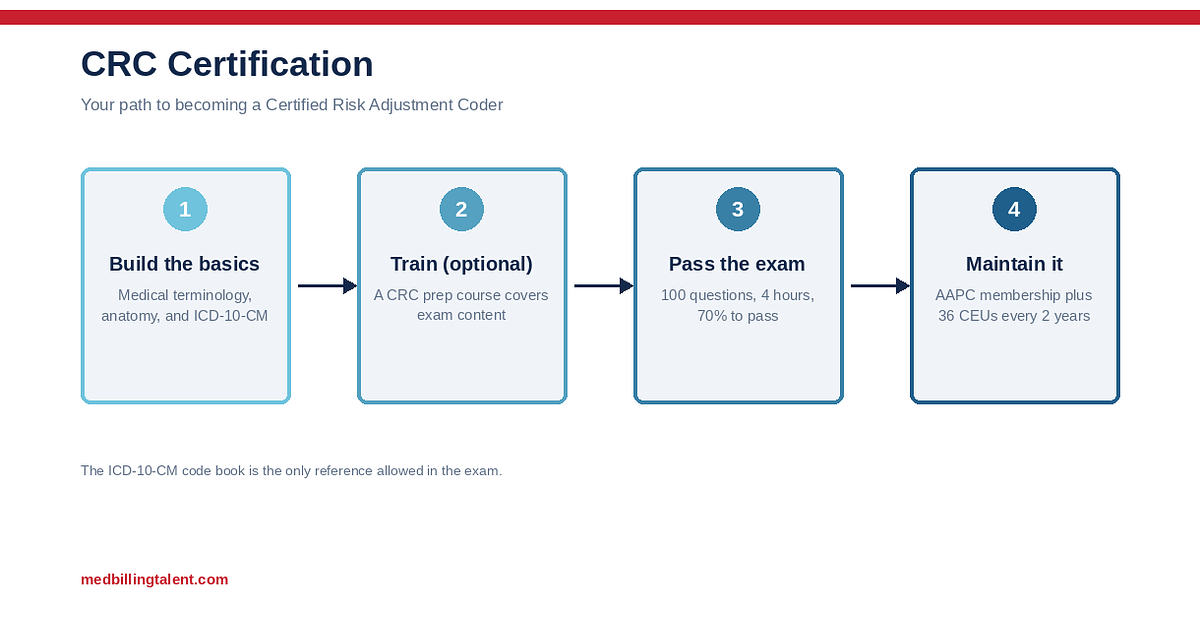
The CRC exam is 100 multiple-choice questions with a four-hour time limit, and you need 70% to pass. It is proctored, and you can take it online or in person. The ICD-10-CM code book is the only reference you may use, and AAPC recommends the current-year edition because code sets update annually.
The content breaks down into a few areas:
- Diagnosis coding, the largest section, including chronic conditions such as heart failure and chronic kidney disease
- Compliance, including prospective, retrospective, and RADV audits and common coding errors found in them
- Risk adjustment models and RAF calculations, and how they affect plan payments
- Documentation requirements for acceptable diagnoses
If you are looking for CRC exam questions to practice, focus on scenario-style items that ask you to code from a short note, since that mirrors the real work.
How Do You Get CRC Certification?
- Build a foundation in medical terminology, anatomy, and ICD-10-CM if you do not already have one.
- Consider a CRC training course. Certified risk adjustment coder training is optional, but AAPC reports that its own students pass more often than those who skip it.
- Purchase the exam through AAPC. AAPC has listed the exam at $499 including two attempts, so confirm current pricing before you buy.
- Pass the exam with at least 70%. If you do not pass, AAPC reports the areas where you scored 65% or below so you can target your retake.
- Maintain the credential with an active AAPC membership and 36 continuing education units every two years.
How Hard Is the CRC Exam, and How Do You Prepare?
Most candidates find the exam manageable with focused study, and AAPC reports that about 80% of its students pass on the first attempt. Preparation that works well:
- Read the ICD-10-CM official guidelines until you can find any section fast, since the code book is your only reference
- Learn which diagnoses map to HCCs and how the hierarchy ranks related conditions
- Study RADV audit basics and the documentation rules that make a diagnosis reportable
- Take timed practice exams so pacing is not a surprise on test day
CRC vs CPC: Which Certification Should You Get?
The CPC (Certified Professional Coder) covers outpatient and physician-based coding across CPT, ICD-10-CM, and HCPCS. The CRC is narrower and goes deeper on diagnosis coding for risk adjustment. If you want general outpatient coding work, the CPC opens more doors. If you want HCC and risk adjustment roles specifically, the CRC is the more direct match. Many coders hold both, and a CPC background makes the CRC easier to pass.
Is the CRC Worth It for Remote Coding Jobs?
For risk adjustment roles, generally yes. Employers such as health plans and risk adjustment vendors often list the CRC as required or preferred, and much of this work is remote. It also supports higher pay over time, which we break down in our risk adjustment coder salary guide. To understand how the work ties into Medicare Advantage payment, see our explainer on risk adjustment coding.
Where to Find Remote Roles
Browse current remote HCC risk adjustment coder jobs, or look at AAPC CPC jobs if you already hold that credential. Every listing on Med Billing Talent is remote and US-based.