Risk Adjustment Coding Explained: RAF Scores and Medicare Advantage
Risk adjustment coding is the work behind how Medicare Advantage plans are paid, and it is one of the most common remote coding specialties. This guide explains what risk adjustment coding is, how HCCs and RAF scores work, what changed with the V28 model, and why audits shape the job. If you are brand new to the topic, start with our plain-English guide to what HCC coding is.
What Is Risk Adjustment Coding?
Risk adjustment coding is the process of reviewing medical records and assigning ICD-10-CM diagnosis codes that accurately show how sick a patient is. Health plans use those codes to predict how much a member's care is likely to cost. A patient with several serious chronic conditions is expected to cost more than a healthy one, and payment is adjusted to match.
If you have searched for "what is risk adjustment coding," the short answer is that it is diagnosis coding with a payment purpose. The goal is not to bill a single visit. It is to make sure every reportable condition is documented and coded correctly each year.
How Does Risk Adjustment Work in Medicare Advantage?
Medicare pays Medicare Advantage plans a fixed monthly amount per member, adjusted by that member's risk score. The score is built from demographic factors such as age and sex, plus the HCCs that the member's diagnoses map to. Diagnoses documented in one calendar year drive the risk score and payment in the following year, which is why chronic conditions must be captured accurately every year.
The ACA individual and small-group markets use a separate but similar model called HHS-HCC. The details differ, but the idea is the same: pay more for patients expected to need more care.
What Is a RAF Score?
RAF stands for risk adjustment factor. It is a number that summarizes a patient's expected costs relative to an average patient, who sits around 1.0. A higher score means higher expected costs and higher payment. Each qualifying HCC adds to the score, and hierarchy rules make sure that only the most severe condition in a related family counts.
What Is the Difference Between HCC and Risk Adjustment?
Risk adjustment is the overall system, and HCCs are the building blocks inside it. An HCC (Hierarchical Condition Category) is a group of related diagnosis codes that carries a weight in the risk model. So when people say HCC risk adjustment, they mean the risk adjustment system that uses HCCs to calculate scores. HCC coding is the hands-on job of finding and coding those diagnoses.
What Changed With CMS-HCC V28?
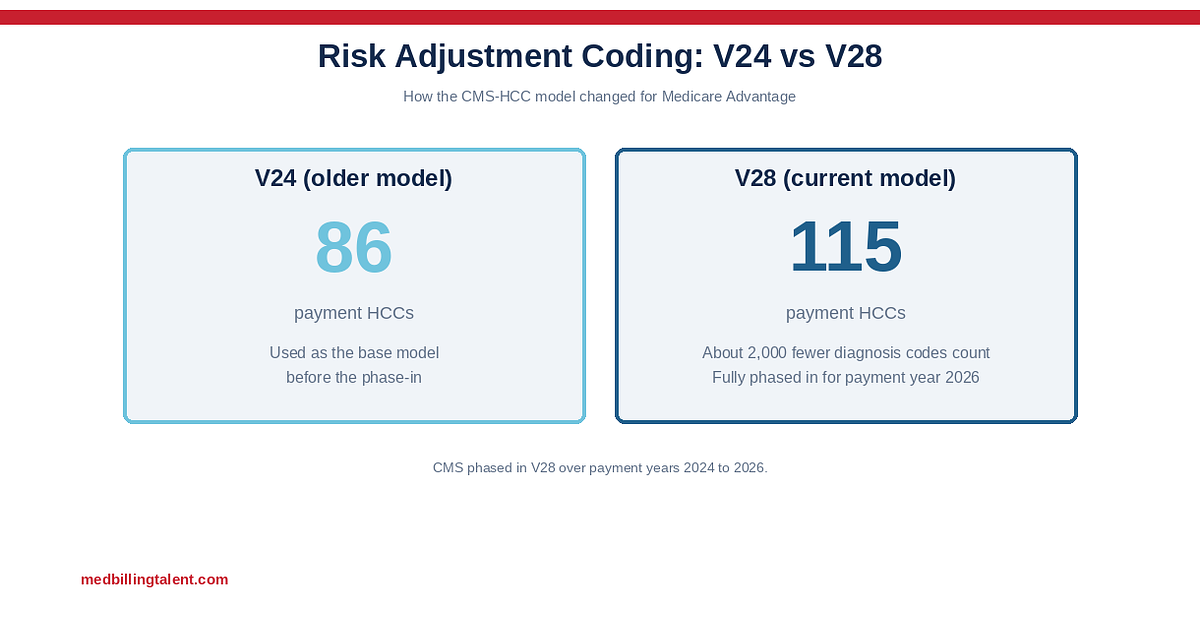
V28 is the current version of the CMS-HCC model. CMS phased it in over three payment years, moving from a mostly V24 blend in 2024 to 100% V28 in 2026. The main changes:
- Payment HCCs rose from 86 in V24 to 115 in V28, with the categories restructured and renumbered
- About 2,000 ICD-10-CM codes that counted toward payment under V24 no longer map to a payment HCC
- Several high-volume conditions, including diabetes and vascular disease, were remapped or reweighted
For coders, the practical takeaway is to code to the specificity the record supports and not to rely on old V24 mappings.
Why Do Audits Matter in Risk Adjustment Coding?
CMS checks risk adjustment data through Risk Adjustment Data Validation (RADV) audits, which compare the diagnoses a plan submitted against the medical record. If a diagnosis is not supported by the documentation, it can be removed and the plan can be required to repay. That is why compliance is a core part of the job and a major topic on the CRC exam. Some coding is prospective, done before a visit to flag documentation gaps, and some is retrospective, done on charts after the visit. Audit-ready documentation is the standard either way. For the credential that covers this, see our CRC certification guide.
Is Risk Adjustment Coding a Remote Job?
Very often. Chart review happens in secure systems, so many health plans, vendors, and provider groups hire risk adjustment coders to work from home. Pay depends on experience and credentials, and you can see current ranges in our risk adjustment coder salary guide.
Where to Find Remote Roles
Browse current remote HCC risk adjustment coder jobs, or look at auditor and CDI jobs if the audit side of the work appeals to you. Every listing on Med Billing Talent is remote and US-based.