Risk Adjustment Coder Salary Guide (2026)
Risk adjustment coding pays well compared with many entry-level coding roles, but the numbers vary a lot depending on the source, the employer, and how much experience you bring. This guide pulls together current national salary data, hourly ranges from a real job posting, and the factors that move pay for risk adjustment and HCC coders. If you are still deciding whether this specialty fits, read what HCC coding is first.
How Much Does a Risk Adjustment Coder Make?
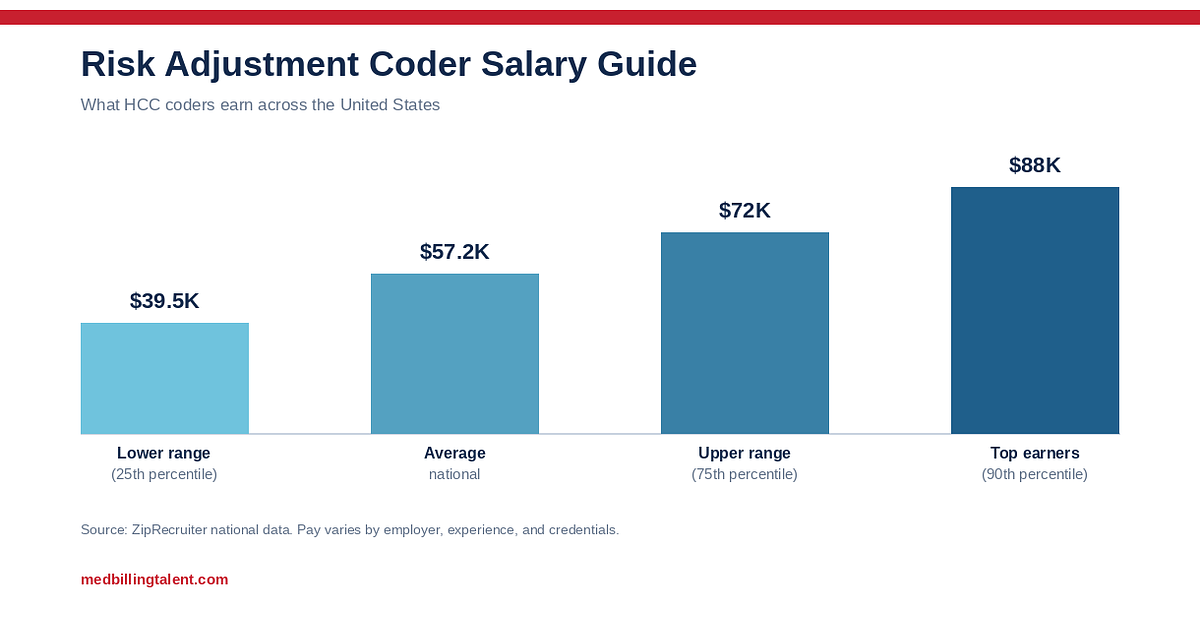
As of September 2026, ZipRecruiter puts the national average for a risk adjustment coder at about $57,200 a year, or roughly $27.50 an hour. Salaries in its data run from about $33,000 to $91,000. Here is how the range breaks down:
- Lower range (25th percentile): about $39,500
- Average: about $57,200
- Upper range (75th percentile): about $72,000
- Top earners (90th percentile): about $88,000
What Is the Average HCC Coder Salary?
HCC coder and risk adjustment coder are largely the same role, so the figures above apply to both. If you searched for the HCC coder salary or the risk adjustment coding salary, use that same range as your starting point.
How Much Do Remote Risk Adjustment Coders Earn?
Sources do not agree on remote pay. ZipRecruiter's figures for remote risk adjustment coding roles average about $44,700 a year, roughly $21.50 an hour, with most listings between about $37,500 and $47,500. That is below its overall national average, so treat remote pay as a wide range and compare each offer against the specific role instead of relying on one number.
What Do Employers Actually Pay Per Hour?
Employer postings are a useful reality check. One Boston-area health system's remote risk adjustment coder posting lists $24.04 to $33.65 an hour, which works out to roughly $50,000 to $70,000 a year at full time. The employer says where you land in the range depends on education, experience, skills, and certifications, and that the range is based on Boston-area data and can change by location.
What Affects Risk Adjustment Coder Pay?
- Experience: postings commonly prefer 2 to 3 years of risk adjustment or HCC coding experience
- Credentials: CPC, CRC, CCS, and RHIT are commonly listed as accepted certifications, and employers say certifications factor into offers
- Location and employer: pay ranges are often set by region, so the same role can pay differently across markets
What Does a Risk Adjustment Coder Do, and How Do You Become One?
Risk adjustment coders review patient records, assign ICD-10-CM diagnosis codes, confirm the documentation supports each one, and query providers when notes are unclear. To get started, build a foundation in ICD-10-CM and medical terminology, earn a credential such as the CPC or CRC (see our CRC certification guide), and gain hands-on experience with HCC review.
How Do You Increase Your Risk Adjustment Coder Salary?
The most reliable levers are experience, credentials, and accuracy under the current model. Learn how V28 changed which diagnoses carry weight in our guide to risk adjustment coding, since coders who code to the specificity the record supports are more valuable to plans and vendors.
Where to Find Remote Roles
Browse current remote HCC risk adjustment coder jobs, or see all remote medical coder jobs. Every listing on Med Billing Talent is remote and US-based.