What Is HCC Coding? A Plain-English Guide for Coders
If you have looked at remote coding job postings lately, you have probably seen "HCC" listed as a required skill. HCC coding is one of the most in-demand specialties in medical coding, and it works differently from the claim-focused coding most people learn first. This guide explains what HCC coding is, how it works, and what HCC coders actually do.
What Is HCC Coding?
HCC stands for Hierarchical Condition Category. HCC coding is the process of reviewing patient records and assigning diagnosis codes that map to these categories, so a health plan can measure how sick its patient population is. Each HCC groups related ICD-10-CM diagnosis codes into a condition family, such as diabetes with complications, heart failure, or COPD.
The model most people mean is the CMS-HCC model, which Medicare uses to adjust payments to Medicare Advantage plans. Sicker patients are expected to cost more to care for, so plans receive more funding for them. That only works if chronic conditions are documented and coded accurately, which is where HCC coders come in.
What Does HCC Stand For in Medical Coding?
In medical coding, HCC means Hierarchical Condition Category. "Hierarchical" matters because related conditions are ranked by severity. If a patient has several diagnoses in the same condition family, only the most severe one counts toward the risk score. Coding a milder condition on top of a more severe one in the same family does not add anything.
How Does HCC Coding Work?
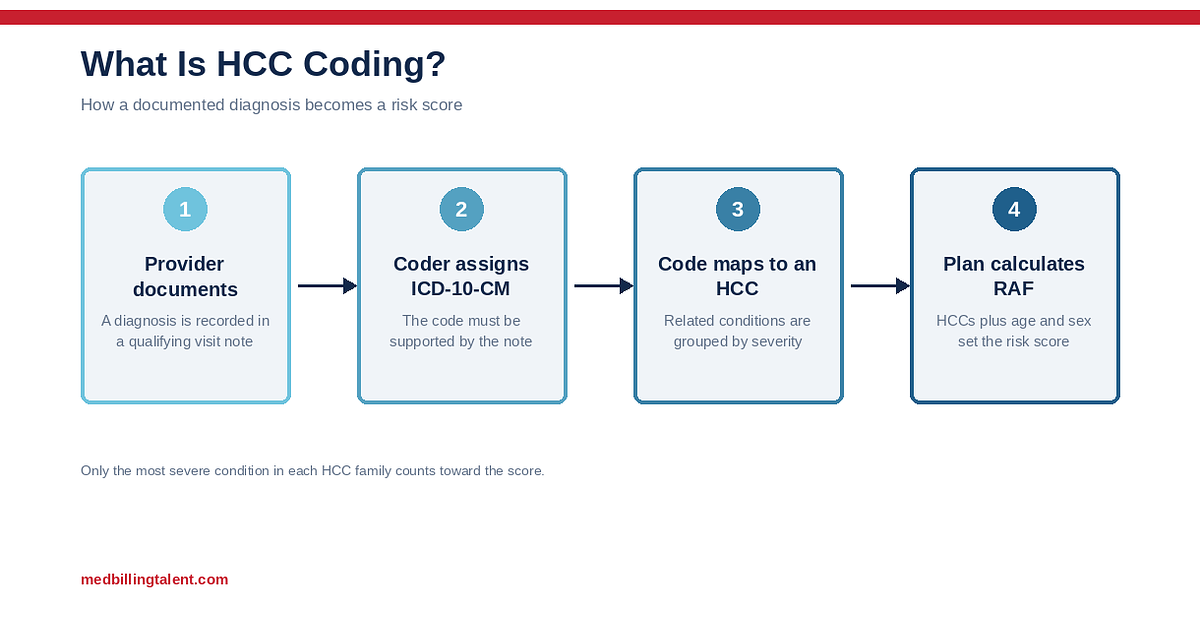
The process follows the same basic path in most organizations:
- A provider documents a diagnosis during a qualifying visit, such as a face-to-face or telehealth encounter.
- The coder reviews the note and assigns the correct ICD-10-CM code, but only if the documentation supports it.
- The code maps to an HCC. Not every diagnosis carries risk weight, so many codes map to nothing.
- The health plan combines the HCCs with demographic factors such as age and sex to produce a risk adjustment factor, or RAF score.
Risk scores reset each calendar year. A chronic condition has to be documented and coded again every year to keep counting, which is why HCC coding is a year-round workflow rather than a one-time task.
Why Does HCC Coding Matter?
Accurate HCC coding affects how much a Medicare Advantage plan is paid, and it helps plans identify patients who need extra care management. It also carries compliance weight. Payers and CMS audit risk adjustment data, including through Risk Adjustment Data Validation (RADV) audits, so every code has to be backed by the medical record. Coding a condition that is not supported is a risk, not a shortcut.
What Does an HCC Coder Do Day to Day?
Most HCC coders spend their day reviewing provider notes in a secure chart system. Typical tasks include:
- Reading charts and assigning ICD-10-CM codes that reflect the documented conditions
- Confirming each diagnosis is supported, often using the MEAT approach (monitor, evaluate, assess, treat)
- Sending queries to providers when documentation is unclear or incomplete
- Flagging documented chronic conditions that were missed on earlier claims
- Meeting accuracy and productivity targets set by the employer
What Skills Do You Need to Become an HCC Coder?
Strong ICD-10-CM knowledge is the foundation, along with a good grasp of chronic disease processes and the ability to spot what a note does and does not support. Attention to documentation detail matters more than speed when you are starting out. Many employers also ask for the CRC (Certified Risk Adjustment Coder) credential from AAPC, and a CPC background makes the transition easier. For the credential path, see our CRC certification guide.
What Is the Difference Between HCC Coding and Regular Medical Coding?
Traditional claim coding focuses on procedures, evaluation and management services, and getting a specific visit billed correctly. HCC coding focuses on capturing diagnoses accurately and specifically, so they reflect a patient's overall health burden across the year. The risk score, not the individual claim, is the end product. To see how those scores connect to Medicare Advantage payment, read our guide to risk adjustment coding.
Is HCC Coding a Remote Job?
Very often, yes. Chart review is done on secure systems, so many health plans, risk adjustment vendors, and provider groups hire HCC coders to work from home. If you are searching for HCC coder remote jobs or remote HCC coder jobs, look for employers that hire in the United States and list clear productivity and accuracy expectations. Pay varies by experience and credentials, which we cover in our risk adjustment coder salary breakdown.
Where to Find Remote Roles
Browse current remote HCC risk adjustment coder jobs, or see all remote medical coder jobs. Every listing on Med Billing Talent is remote and US-based.