What Is Clinical Documentation Improvement (CDI)? (2026)
Clinical documentation improvement (CDI) is one of the most important, least understood parts of the healthcare revenue cycle. If a patient's medical record doesn't accurately capture the full picture of their care, hospitals get underpaid, quality data gets skewed, and compliance risk goes up. CDI exists to fix that.
What is CDI?
CDI is the process of reviewing clinical documentation, the notes, orders, and records created during a patient's care, to make sure it's complete, specific, and accurately reflects the severity of illness and services provided. It sits between clinical care and medical coding: coders can only assign codes based on what's actually documented, so if the documentation is vague or incomplete, the codes (and the resulting reimbursement) will be too.
Why CDI matters
- Accurate reimbursement: hospitals are paid based on diagnosis codes, which come directly from documentation - incomplete notes mean lost revenue
- Quality metrics: publicly reported quality scores and risk-adjustment data depend on documentation accurately reflecting patient acuity
- Compliance: both under-documentation and over-documentation create audit and compliance risk
- Patient record accuracy: a more complete record supports better continuity of care
How the CDI process works
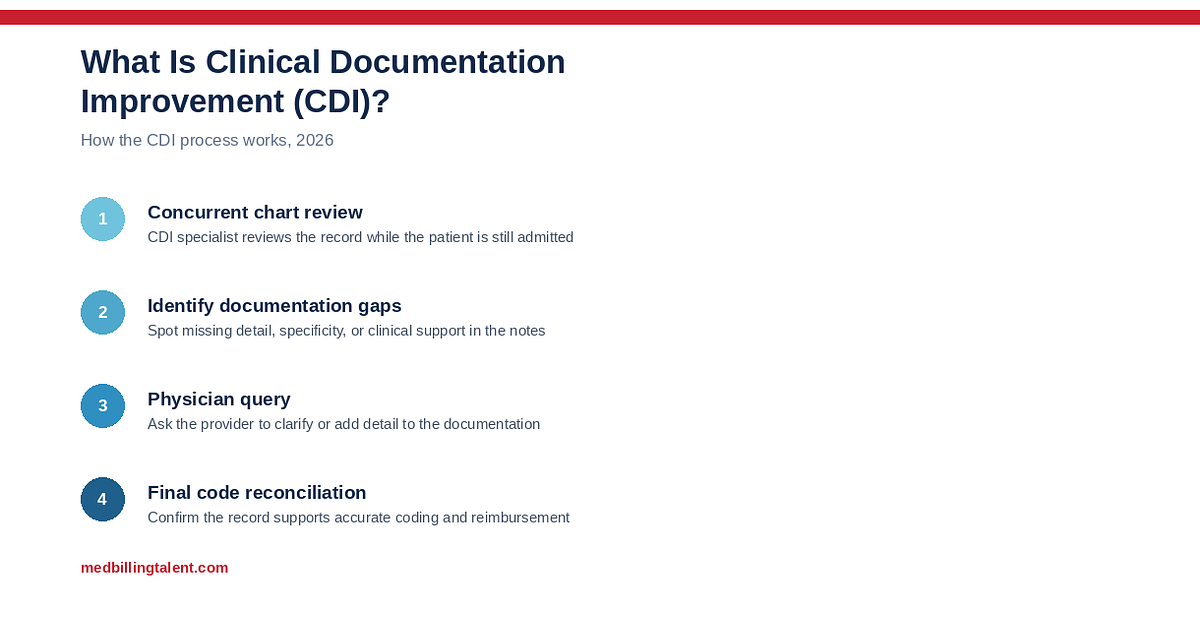
- Concurrent chart review - a CDI specialist reviews the patient's record while they're still admitted, not after the fact
- Identify documentation gaps - looking for missing specificity, unclear diagnoses, or clinical indicators that aren't reflected in the notes
- Physician query - reaching out to the provider, often through a formal query process, to clarify or add detail
- Final code reconciliation - confirming the finished record supports accurate coding before the claim goes out
Who does CDI work?
CDI specialists come from two main backgrounds: registered nurses with clinical experience, and medical coders with strong knowledge of coding guidelines. Both bring something different: nurses understand clinical nuance, while coders understand exactly what documentation translates into which codes. Many CDI teams are a mix of both.
CDI vs. medical coding vs. auditing
These three roles are closely related but distinct. Coders assign codes based on what's documented, after the fact. CDI specialists work concurrently, while the patient is still in the hospital, to improve the documentation itself before coding happens. Auditors typically review completed records after the fact to check for accuracy and compliance. Many professionals move between these roles over the course of a career.
Where to find remote CDI jobs
Med Billing Talent lists current remote, US-based CDI and auditing openings, screened to exclude offshore and outsourced postings. Browse Auditor / CDI jobs →